How Salt’s Origins Shape Local Cooking Customs
Learn how salt origins connect to local cooking customs, with ways to trace a source, describe a dish’s technique, and keep cultural details distinct.
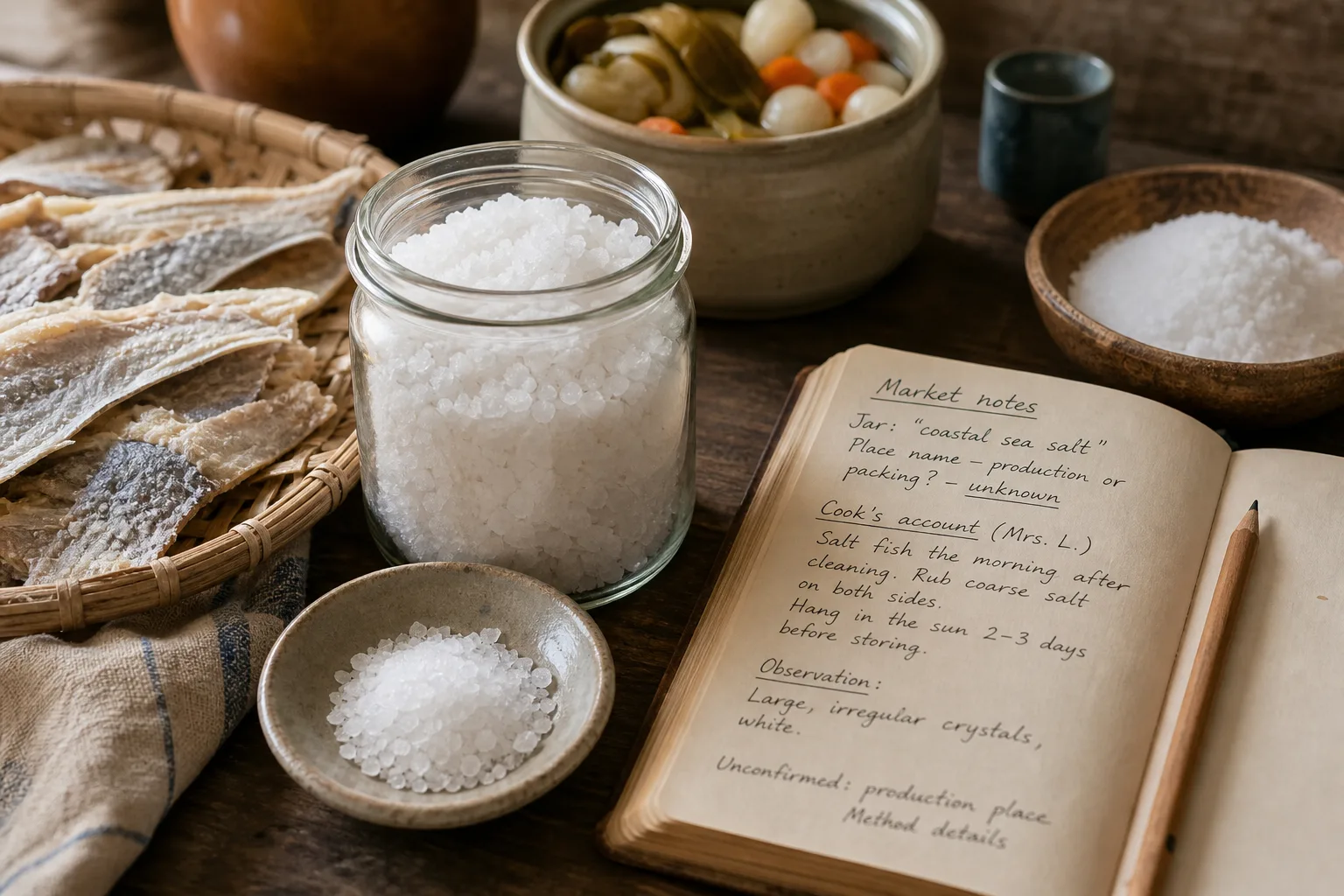
At a neighborhood market, a basket of dried cod may sit near jars of pickled vegetables and coarse salt. Salt origins help explain the landscapes behind an ingredient, while local cooking customs show how salt enters particular dishes and preservation traditions.
Seawater, underground deposits, and concentrated brine offer different routes to salt. Production, processing, packing, and cooking are separate parts of that route, like stops on a bus line rather than interchangeable place names.
Trace salt origins
Read the package for a stated source, production place, and processing method. A place name might refer to where salt was produced, where it was packed, or a regional style. Those descriptions answer different questions, so keep them distinct.
Salt may be produced by evaporating seawater in shallow beds, mining underground deposits, or concentrating brine. Local geology, water, climate, and labor shape the work. Coastal salt beds and inland mines are different working landscapes, even when their products season similar meals.
Texture and color describe what you see and feel, but they do not establish where salt came from. If a package leaves a detail unclear, ask the seller what the label means or mark that detail unconfirmed.
Follow salt into dishes
Notice when salt enters a familiar dish: dissolved in cooking water, rubbed onto vegetables, stirred into sauce, or added at the table. Record the dish and timing together. That gives a more useful account than saying only that a household uses a certain salt.
Salt’s place in a food tradition can involve preservation as well as seasoning. In coastal communities, salting and drying fish have helped make catches useful beyond the fresh catch; in households that pickle vegetables, salt may draw out moisture before fermentation or storage. The ingredients and techniques vary by place and family, so describe the particular practice rather than assigning one method to an entire region.
For instance, “salt added while beans simmer, then adjusted alongside sour greens” describes a cooking sequence. If a family recipe calls for a particular kind, record it as that household’s account rather than a rule for everyone from the same region. A cook’s explanation may center on availability, texture, memory, or a practical part of preparation; let the person describe the reason in their own terms.
Compare samples in context
Use the same familiar food and preparation method when comparing salts. Notice how each dissolves, whether its texture remains apparent, and how it sits beside other flavors. Describe what you perceive without treating a sensory difference as proof of origin or as a ranking of traditions.
Say you have coarse sea salt with a named coastal origin and fine salt from a shop whose package names no source. You set out two potatoes, boil each in separate pots using the same amount of water, and season each portion with a small pinch of one salt. You note that the coarse crystals remain noticeable while the fine salt dissolves quickly, then ask the shopkeeper what the second label refers to. If the shopkeeper cannot clarify, record the texture you observed and leave the source unknown; the comparison does not identify where either salt was produced.
Questions about salt origins?
How is sea salt made?
In some places, seawater flows into shallow ponds and evaporates until crystals can be collected. Weather, water management, and the work of tending the beds shape the process.
Is mined salt different from sea salt?
Mined salt comes from underground deposits, while sea salt is produced from seawater. Processing and crystal size can vary, so source alone does not describe every difference a cook may notice.
Why do some foods use salt for preservation?
Salting can help prepare foods such as fish and vegetables for drying, pickling, or other preservation methods. The role of salt depends on the ingredient and preparation; follow a reliable recipe for food-preservation instructions rather than improvising a method.
What does a salt label tell me?
Look for the stated source, production place, and processing details, and distinguish those from the packing location. If the wording is unclear, ask the seller what it refers to or leave the detail unconfirmed.
Make useful field notes
Keep notes brief and specific. For each package or cooking account, check the detail and choose what to record based on what you can verify:
- Check whether a place name refers to production or packing; if the label says which, record that role, but if it does not, ask the seller or mark the role unknown.
- Check whether the package names evaporation, mining, or brine concentration; if it names a method, record it, but if it does not, leave the method unconfirmed.
- Check which dish uses the salt and when it enters preparation; if a cook describes a specific practice, attribute it to that cook or household, but if no account is available, do not present a regional custom as established.
- Check how a preservation practice is described; if the cook names an ingredient and method, record both, but if the account is general, ask for clarification or avoid filling in the missing details.
- Check the sample’s texture and appearance; if you notice a difference, describe it plainly, but if you do not, do not infer that the salts share an origin.
- Check who shared information about a cooking practice; if a household provided it, identify it as a household account, but if the source is unclear, avoid generalizing the claim.
- Check whether any label detail remains missing; if the seller clarifies it, record the answer and who provided it, but if not, keep the gap visible rather than guessing.
Imagine a market notebook entry beginning with a jar labeled “coastal sea salt,” a bag of dried fish, and a cook’s account of seasoning fish before hanging it to dry. First, copy the label wording and ask the seller whether the place name identifies production or packing; if the answer is unclear, mark that point unknown. Next, ask the cook which salt they use and when they add it; if they describe their own household’s method, attribute the account to that household. Finally, note the visible crystals and the stated preparation without treating either as proof of the other. The result is a grounded account of salt origins and local cooking customs, with the production claim, cooking practice, and unresolved details kept separate.
That separation makes a small observation—such as when salt enters a pot, or what a market label actually names—useful without turning one household’s practice into a claim about everyone nearby.
Keep exploring

The Orchard Between Two Kitchens
Trace how apples take on different roles across neighboring food traditions, and learn to choose a…

A Market Stall Has Its Own Geography
Market stall geography helps you trace one ingredient from its stated source through the market, so…