A Market Stall Has Its Own Geography
Market stall geography helps you trace one ingredient from its stated source through the market, so you can separate known details from assumptions.
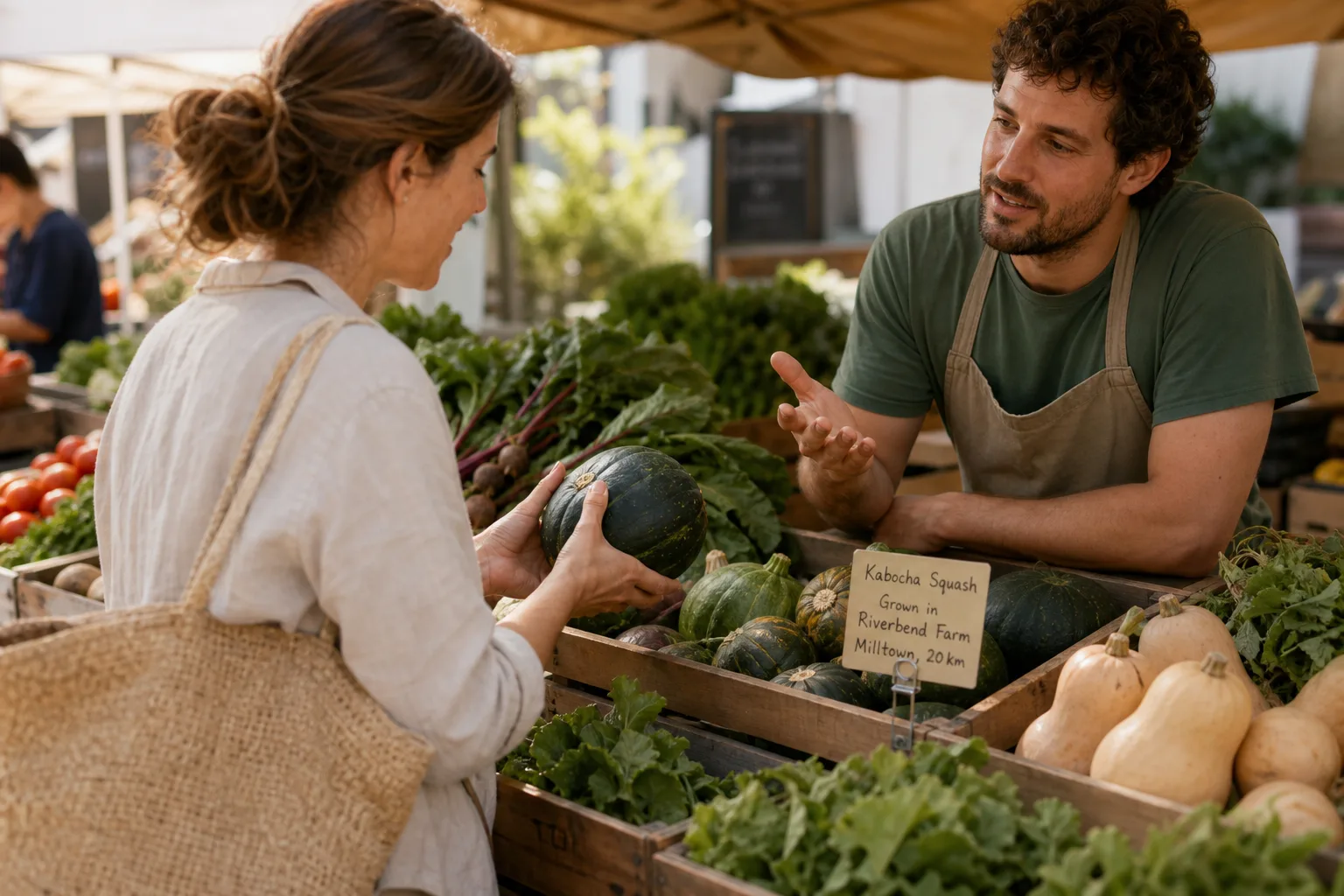
You reach for a bunch of greens and notice that its card names a growing region several towns away. Market stall geography begins with details like that: a label, a crate, a route through the aisle, and the questions a vendor can answer about a particular batch.
Stalls are not just displays. They are small points in a supply chain, where goods are received, sorted, stored, sold, and passed on to home cooks or restaurants. Following one ingredient through those stages can show how food moves without turning a display into a story it cannot support.
Read the Display
Look at how goods are arranged, but treat placement as a clue about handling rather than proof of origin. Greens may be kept near a cooler; sturdy roots may be stacked in crates; fragile fruit may sit away from the aisle. Those choices can reflect storage needs, unloading routines, or the flow of customers.
Ask the vendor what happens when a delivery arrives. Does someone sort the boxes before opening the stall? Are delicate items moved into shade? The answers connect the visible layout to daily work and may explain why one ingredient is easy to reach while another is set farther back.
A stall can work like a well-used kitchen drawer: the objects within reach are often there for practical reasons, not because they share an origin. The analogy is useful for reading the arrangement, but the vendor or a batch-specific label is needed to establish a source.
Trace One Ingredient
Choose a single item and follow its route in order: growing place, supplier, arrival at the market, handling at the stall, and sale. Keep each answer attached to that item and batch. A market that favors regional producers gives useful context, but it does not establish where every product on every table came from.
Ask plainly: “Where was this batch grown?” and “Did it come directly from the grower, or through a distributor?” If the vendor cannot say, leave that part of the route unknown. Season and appearance can prompt a question, but neither establishes origin on its own.
Pay attention to what happens when a crop becomes scarce or another takes its place. A vendor may describe a changed supplier, a different growing area, or a shift in what customers request. Such details show how supply and cooking habits meet at the stall, without representing every household nearby.
Follow the Sale
The route continues after the goods reach the table. Loose produce lets a shopper select an amount; a bundle offers a set; a prepared portion may be intended for a particular use. These formats describe the seller’s options, not a universal preference among local cooks.
Listen to the questions people ask about an unfamiliar vegetable, a smaller portion, or an ingredient for a particular dish. A vendor might explain a preparation method, adjust a quantity, or suggest another item. Those exchanges reveal how the stall responds to individual needs; they cannot stand in for the whole neighborhood’s food culture.
Notice where customers take their purchases if the route is visible and the setting makes it appropriate to observe. A bag carried toward nearby restaurants tells you something about that transaction, while a conversation with the vendor may clarify whether the stall also supplies kitchens by arrangement.
Market Stall Geography Questions?
Does a stall layout reveal where food was grown?
No. Placement more often reflects display, storage, or handling, so check a label for the current batch or ask the vendor about its source.
How should I ask if produce is local?
Ask where that specific batch was grown and how it reached the stall. If the answer is uncertain, leave the origin unconfirmed instead of inferring it from season or appearance.
Why might a market’s selection change?
Growing conditions, storage, transport, and purchasing choices can all shape what is available. Ask whether the vendor knows what changed in the supply or expects a different source next.
What do loose and bundled sales tell me?
They show which buying formats the stall offers. They may reflect practical selling choices, but they do not establish what all nearby cooks want.
A Worked Stall Exchange
Say you want squash for dinner and see a card naming a nearby growing area. In this invented situation, the vendor says the card applies to the current crate and that the squash came directly from the farm named on it. You ask for a small portion, and the vendor offers a smaller selection with a simple roasting suggestion. Your decision is to buy that portion if it suits your meal and treat the farm as the stated source for this batch; if you need a different amount, ask what else is available. The exchange does not establish the origins of other goods at the stall.
Checks at the Stall
- Check whether an origin card names a place and applies to the current batch. If both are clear, note that stated source; if either is unclear, ask the vendor or leave the origin unknown.
- Check whether the vendor identifies a grower or distributor as the supplier. If a direct grower is named, record that stated route; if the route is uncertain, ask whether an intermediary handled the item.
- Check where chilled or delicate goods are kept and ask how they are handled. If the setup and explanation make sense for the item, continue considering it; if not, ask for clarification or choose another product.
- Check whether the item is loose, bundled, weighed, or sold as a prepared portion. If the format suits your meal, choose it; if it does not, ask for another option or select a different item.
- Check whether the vendor connects a seasonal item to a specific source. If both timing and origin are explained, keep those details with that item; if not, do not infer local origin from freshness or appearance.
- Check whether a cooking suggestion fits your ingredients and available time. If it does, use it; if it does not, ask for another method or rely on a recipe you already know.
Market stall geography becomes clearer when you follow one ingredient and keep confirmed details separate from open questions. On your next visit, ask about one batch rather than trying to map the entire market at once. That narrow route gives you a more reliable account—and leaves room for the parts the stall cannot tell you.
Keep exploring
The Orchard Between Two Kitchens
Trace how apples take on different roles across neighboring food traditions, and learn to choose a…
How Salt’s Origins Shape Local Cooking Customs
Learn how salt origins connect to local cooking customs, with ways to trace a source, describe…